 Engagement ring with one diamond
 Engagement ring with scattered diamonds
 Wedding ring for her
 Wedding ring for him


 About the brand
 How diamonds grow
 Blog
Blog
 Solo community
 Media
Media
 About diamonds in simple words

 Ukraine
 Europe
 United States
How to tell a lab-grown diamond from a natural diamond
Can you tell a lab-grown diamond from a natural one just by looking at it? We explain which methods actually work, what a gemologist looks for during professional examination, and how to verify a diamond’s origin using a certificate and laser inscription.
01.09.2026
from Julia Kusher
5 min read
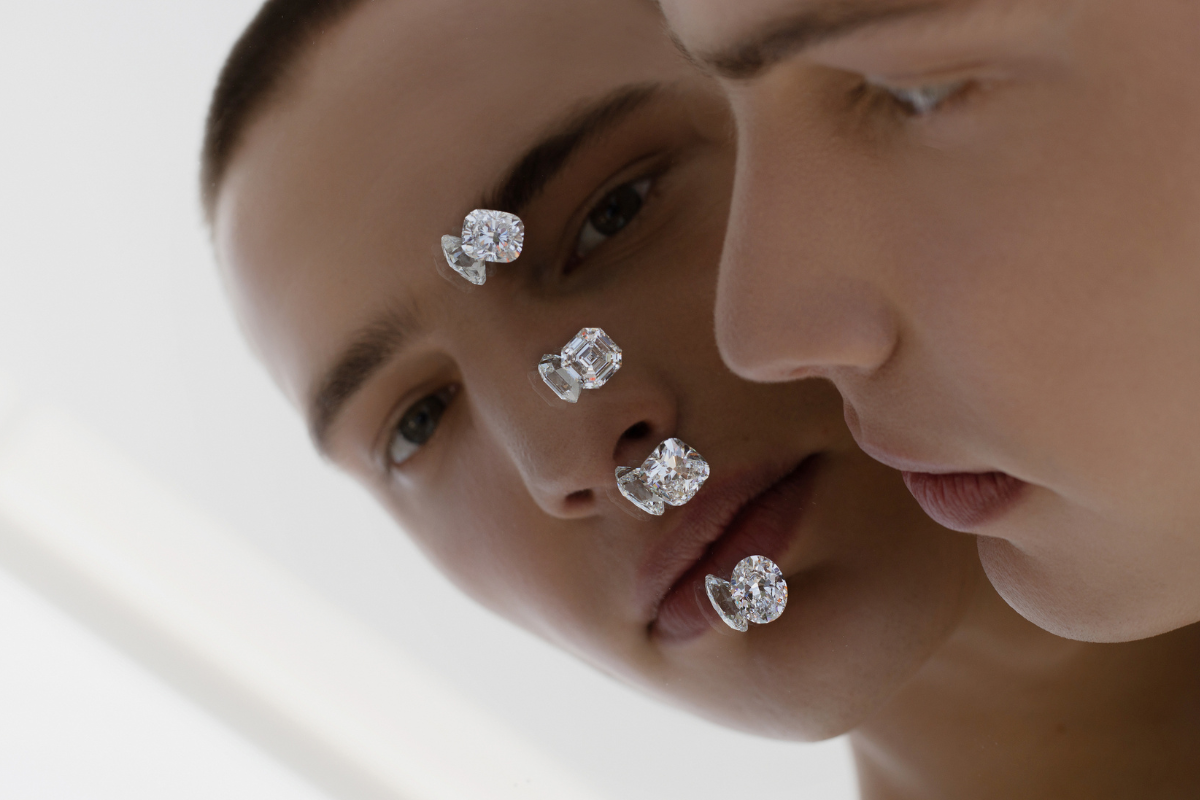
Reliably — you can’t. The origin of a stone cannot be determined with the naked eye or even with most standard consumer diamond tests. Lab-grown diamonds have the same chemical composition, crystal structure, hardness, and optical properties as diamonds of natural origin.
Only a gemologist using specialized equipment can distinguish a natural diamond from a lab-grown one. Therefore, this is not a question of the stone’s appearance, but of professional diagnostics and the results of a gemological examination.
The Main Confusion: A Lab-Grown Diamond Is Not an Imitation
Before looking at how to distinguish lab-grown and natural diamonds, it is important to separate two different questions: how to determine a stone’s origin and how to distinguish it from an imitation.
Moissanite, cubic zirconia, and glass are not diamonds. They are imitations — synthetic materials with different physical and optical properties. Tests for thermal conductivity, density measurements, and specialized instruments can be used to identify them.
The situation is different with a lab-grown stone. Lab-grown diamonds are real diamonds grown using HPHT or CVD technologies. They consist of carbon and have the same crystal structure, a hardness of 10 on the Mohs scale, and the same fundamental physical properties as natural stones. The difference lies in their origin: one formed naturally deep within the Earth, while the other was grown in a laboratory under controlled conditions.
That is why natural and lab-grown diamonds should not be contrasted as “real” versus “fake.” They are diamonds of the same mineral species, but with different origins.
The origin, characteristics, and properties of these stones are discussed in more detail in the article “What Are Lab-Grown Diamonds (Complete Guide).”
Why You Cannot Tell a Lab-Grown Diamond by Sight
Appearance does not provide a reliable answer to which type of diamond you are looking at. Color, clarity, shape, and cut quality can be very similar regardless of origin, so it is impossible to determine a diamond’s origin based on appearance alone.
The most popular home-testing methods — water, breath, or scratching with sandpaper — cannot establish a diamond’s origin. A loupe can help you examine inclusions, but they are not sufficient on their own to determine origin. A standard diamond tester can also confirm that you are dealing with a diamond, but it will not necessarily show whether the stone is natural or lab-grown.
Therefore, determining origin requires not household tests, but a professional gemological report.
This is also why synthetic imitations and lab-grown diamonds are not the same thing. The former only reproduce the appearance of a diamond, while the latter have the same fundamental mineral nature.
We discuss the main characteristics and principles of diamond grading in detail in the article “The 4Cs and Diamond Properties at SOLO.”
What a Gemologist Actually Sees: Real Technical Differences
Professional origin determination is based not on a single characteristic, but on a combination of factors. A gemologist analyzes the stone’s internal structure, spectral properties, reaction to ultraviolet light, and the nature of its inclusions.
1. Diamond Type and Nitrogen Impurities
One important characteristic is diamond type classification. It is related to the amount and form of nitrogen impurities in the crystal.
Around 98% of natural diamonds are Type Ia, in which nitrogen is present in specific aggregates. Type IIa is also found among natural diamonds and contains very little or virtually no nitrogen.
Many CVD diamonds are Type IIa, while some HPHT diamonds are characterized by Type Ib, with nitrogen present as individual atoms. Modern growing technologies can produce stones with different characteristics, so diamond type is only one of the indicators considered during examination.
2. Inclusions and Growth Features
The formation process leaves certain traces within the crystal.
Some HPHT diamonds may contain metallic inclusions associated with the metallic growth medium. CVD diamonds can show characteristic growth-zone features and carbon-related inclusions.
In natural stones, inclusions form during geological processes and can differ in their nature and distribution from those that develop under laboratory conditions. The internal characteristics of lab-grown diamonds also depend on the specific growth technology and conditions.
3. Fluorescence and Phosphorescence
Under ultraviolet radiation, some diamonds exhibit fluorescence — a glow that occurs while exposed to UV light. Certain stones can also exhibit phosphorescence, meaning they continue to glow after the ultraviolet source has been removed.
The nature of this reaction can provide a gemologist with additional information about the characteristics of a particular stone.
4. Spectral Characteristics
For more complex cases, spectroscopy is used. Instruments analyze how the stone interacts with specific regions of the electromagnetic spectrum and help identify characteristics associated with impurities and defects in the crystal structure.
None of these characteristics alone determines a diamond’s origin. It is the combination of results — including diamond type, inclusion characteristics, reaction to ultraviolet light, and spectral properties — that allows a specialist to reach a well-founded conclusion following a comprehensive professional examination.
Real technical features a gemologist may analyze include:
- crystal type and the nature of nitrogen impurities;
- inclusion and growth-zone characteristics;
- reaction to ultraviolet light, including fluorescence and phosphorescence;
- spectral characteristics;
- features of the crystal structure and defects;
- where necessary, the results of a comprehensive examination using specialized equipment.
These characteristics help determine a stone’s origin, although none of them is universally conclusive on its own.
The technologies used to grow diamonds are discussed separately in the article “HPHT and CVD: How Diamonds Are Grown.”
The Most Reliable Method: Certification and Laser Inscription
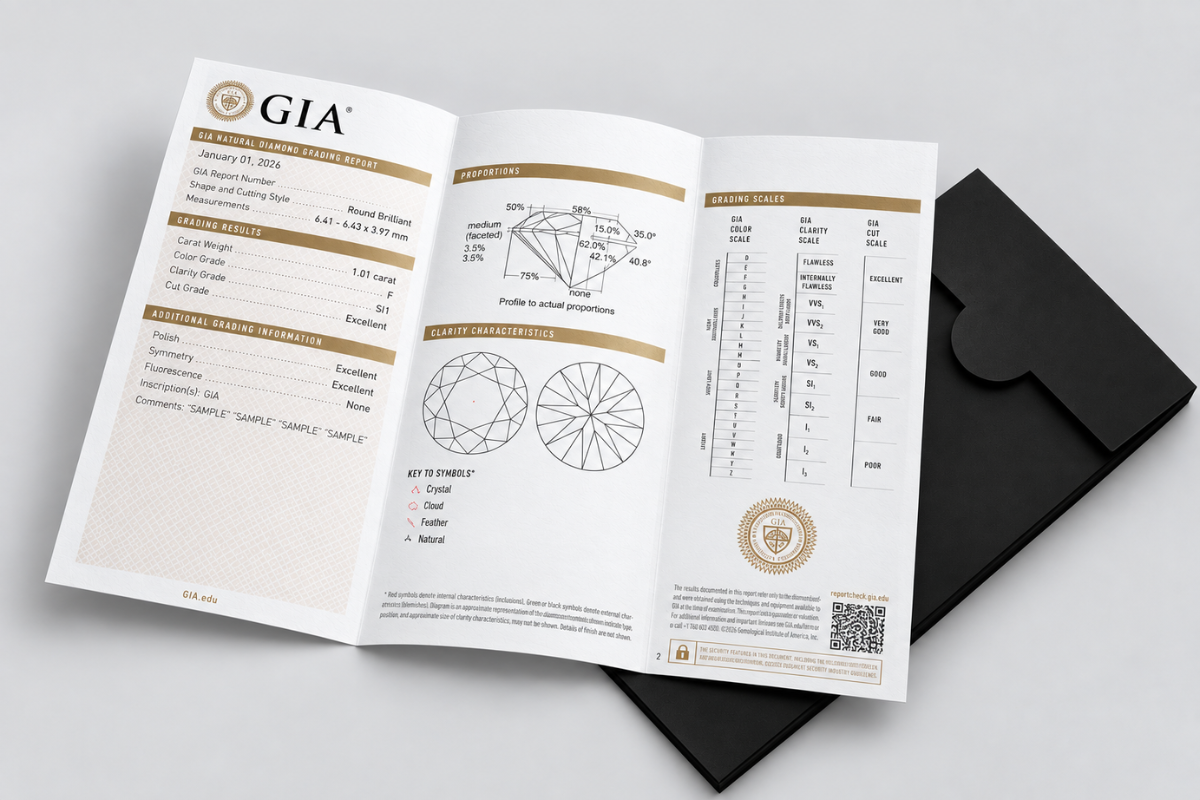
For a buyer, the simplest way to confirm a diamond’s origin is to check its gemological report. Laboratories such as GIA, IGI, and HRD examine diamonds and provide information about their origin in their documentation.
A report for a lab-grown or natural stone explicitly states its origin. Therefore, a GIA certificate or report from another reputable gemological laboratory is a much more reliable source of information than a consumer test. If a lab-grown diamond has an independent gemological report, its origin can be verified using the information in the documentation and, where applicable, the laser inscription.
Another useful indicator is a laser inscription on the girdle — the thin edge between the upper and lower parts of the diamond. A certified stone may have its report number inscribed there, which can be viewed under magnification and matched with the number in the documentation.
Reports from different gemological laboratories may have different formats, but the verification principle remains similar: the number and characteristics stated in the report should correspond to the specific stone.
It is important to check not only whether the document exists, but also whether its information matches the actual stone: the report number, characteristics, shape, weight, and other parameters. Some stones are sold without independent certification, so the absence of a document should not be treated as proof of any particular origin. To verify that a stone corresponds to its documentation, compare its main characteristics and the report number, if one is inscribed on the girdle.
For brands and buyers who want to learn more about how diamond characteristics are verified, the article “SOLO for Diamonds Quality Guarantee” may also be useful.
Jewelry and Diamond Origin
Once a diamond is set in jewelry, checking it yourself can be more difficult than examining a loose stone. In rings and earrings, the girdle is often partially or completely covered by metal, making it difficult or even impossible for a buyer to see the laser inscription with a loupe.

This is worth considering when choosing a finished piece of jewelry. For example, earrings with lab-grown diamonds and rings with lab-grown diamonds may contain stones whose girdles are not fully accessible for inspection because of the setting. Therefore, being unable to see the inscription directly on the stone does not mean that its origin cannot be verified.
In this case, it is important to request a separate gemological report for the diamond itself rather than relying solely on the store’s description of the finished piece. The document should specify the characteristics and origin of the particular stone. If the stone has a report number inscribed on its girdle, it can be matched with the documentation when the inscription is accessible for inspection.
Therefore, when purchasing finished jewelry, the key factor is not whether you can personally examine the girdle, but whether documentation for the diamond itself is available. A certificate for the stone should exist regardless of whether the diamond is sold loose or already set in a ring, earrings, or another piece of jewelry.
[products]
A Quick Check at a Glance
If you need to quickly assess a stone before purchasing, it is enough to remember a few basic rules:
Before buying, check not only the appearance, but also the documentation and main characteristics of the stone:
- ask for a GIA, IGI, or HRD gemological report that clearly states the stone’s origin;
- check the number on the girdle with a loupe and match it with the number in the report;
- do not rely on home tests — water, sandpaper, or a standard diamond tester cannot determine origin;
- if in doubt, consult an independent gemologist.
A Difference in Origin, Not Authenticity
The question of how to distinguish a lab-grown diamond from a natural one is not really about finding a “fake”: a lab-grown stone is a real diamond, and the difference lies specifically in its origin. Natural diamonds form through natural geological processes, while lab-grown diamonds are grown under controlled conditions using HPHT or CVD technologies.
It is impossible to determine origin based on appearance or household tests. Reliable confirmation comes from professional gemological diagnostics and independent documentation, including a certificate or report containing the characteristics of the specific stone.
FAQ
Does being lab-grown affect the value of a piece of jewelry?
Does the certificate state that a diamond is lab-grown?
Can you tell if a diamond is lab-grown at home?




you may also be interested in
14.08.26
7 myths about lab-grown diamonds that are time to dispelAre lab-grown diamonds real or not? We explain in simple terms how they differ from natural diamonds and what to consider when choosing a piece of jewelry. We separate facts from common misconceptions to help you better understand the stone and make an informed choice.
read22.07.26
Diamond engagement ring. A tradition that became a symbol of loveA marriage proposal is one of the most important moments in the lives of two people. Today, it is almost impossible to imagine it without a piece of jewelry that has become a universal symbol of commitment, trust, and the desire to build a future together.
read05.08.26
What are lab-grown diamonds: a complete guide in simple wordsLab-grown diamonds are real gemstones that differ from natural diamonds only by their origin. Discover everything you need to know about HPHT and CVD technologies, certification, differences from natural diamonds, and key factors to consider when choosing a diamond.
read05.08.26
HPHT vs. CVD: how are diamonds really grown in a laboratory?Discover how modern technology transforms carbon into a real diamond, the stages each crystal goes through, and the key differences between the HPHT and CVD growing methods.
read whatsapp
 Telegram
 EMail
EMail