 Engagement ring with one diamond
 Engagement ring with scattered diamonds
 Wedding ring for her
 Wedding ring for him


 About the brand
 How diamonds grow
 Blog
Blog
 Solo community
 Media
Media
 About diamonds in simple words

 Ukraine
 Europe
 United States
Diamond certificate: IGI or GIA — what’s the difference for lab-grown diamonds and which one matters more
IGI or GIA: which certificate should you choose for a lab-grown diamond? We compare the laboratories’ approaches, the 4Cs grading system, and GIA’s new grading rules.
04.09.2026
from Julia Kusher
5 min read
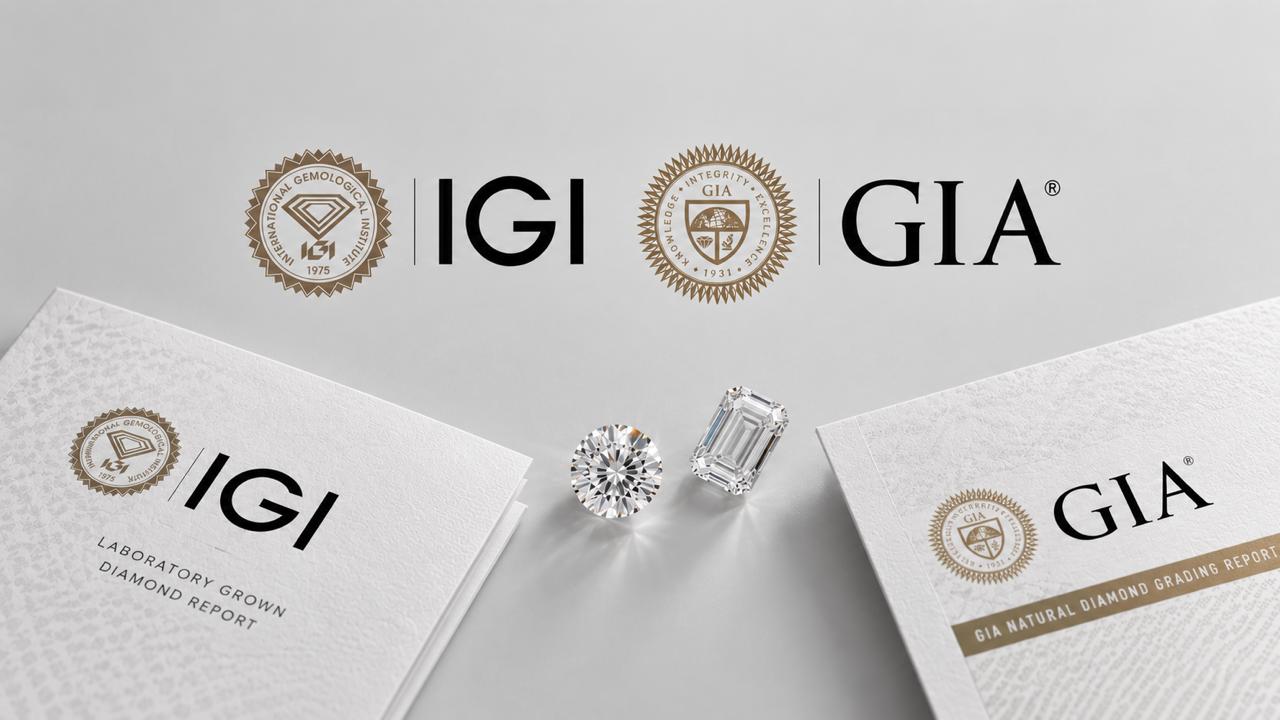
When it comes to a diamond certificate, buyers most often come across two names — GIA and IGI. Both are well-known gemological laboratories that identify a stone’s origin and evaluate its characteristics. However, for lab-grown diamonds, the difference between them has become particularly noticeable following GIA’s change in approach in 2025.
If we answer the question of IGI or GIA briefly, IGI is currently a more practical choice for most buyers of lab-grown stones because its reports continue to provide a detailed 4Cs assessment — carat weight, color, clarity, and cut. GIA also certifies lab-grown diamonds, but since October 1, 2025, it has used a new overall assessment system of Premium / Standard for colorless and near-colorless stones instead of traditional color and clarity grades.
This does not mean that a GIA certificate is worse or that an IGI certificate is less reliable. The main difference lies in the methodology, report format, and the type of information a buyer wants to receive about a specific lab-grown diamond.
GIA and IGI — a brief overview of both laboratories
GIA — the Gemological Institute of America — is an independent nonprofit organization founded in 1931. GIA is closely associated with the development of the international 4Cs system — Color, Clarity, Cut, and Carat Weight. GIA certification is widely regarded as a benchmark approach to evaluating diamonds and other gemstones.
IGI — the International Gemological Institute — was founded in Antwerp in 1975. Since 2005, IGI has specialized in evaluating lab-grown diamonds and has become one of the key players in this category, although both laboratories operate in the field of diamond certification.
The key difference: how GIA and IGI grade lab-grown diamonds
This is where the main distinction between the two laboratories lies today.
Previously, buyers of lab-grown stones could compare GIA and IGI reports using familiar parameters: for example, D or G for color on the D-to-Z scale, and VS1 or SI1 for clarity. This format made it convenient to compare stones directly.
In June 2025, GIA announced a change in its approach. Since October 1, 2025, GIA has used an overall Premium or Standard assessment for colorless and near-colorless lab-grown diamonds. This system differs from the traditional 4Cs grading of color and clarity.
IGI, by contrast, has confirmed that it continues to use the traditional 4Cs system for both lab-grown and natural diamonds. Its reports can show specific color and clarity grades — for example, G/VS1 or E/VVS2.
This has practical implications for buyers. If it is important to compare two stones specifically by color and clarity, an IGI report currently provides a more detailed picture.
At the same time, it would be incorrect to say that GIA has “stopped grading” lab-grown diamonds. It continues to analyze them and issue Quality Assessments with a Premium or Standard category.
Why IGI has become so important to the lab-grown diamond market
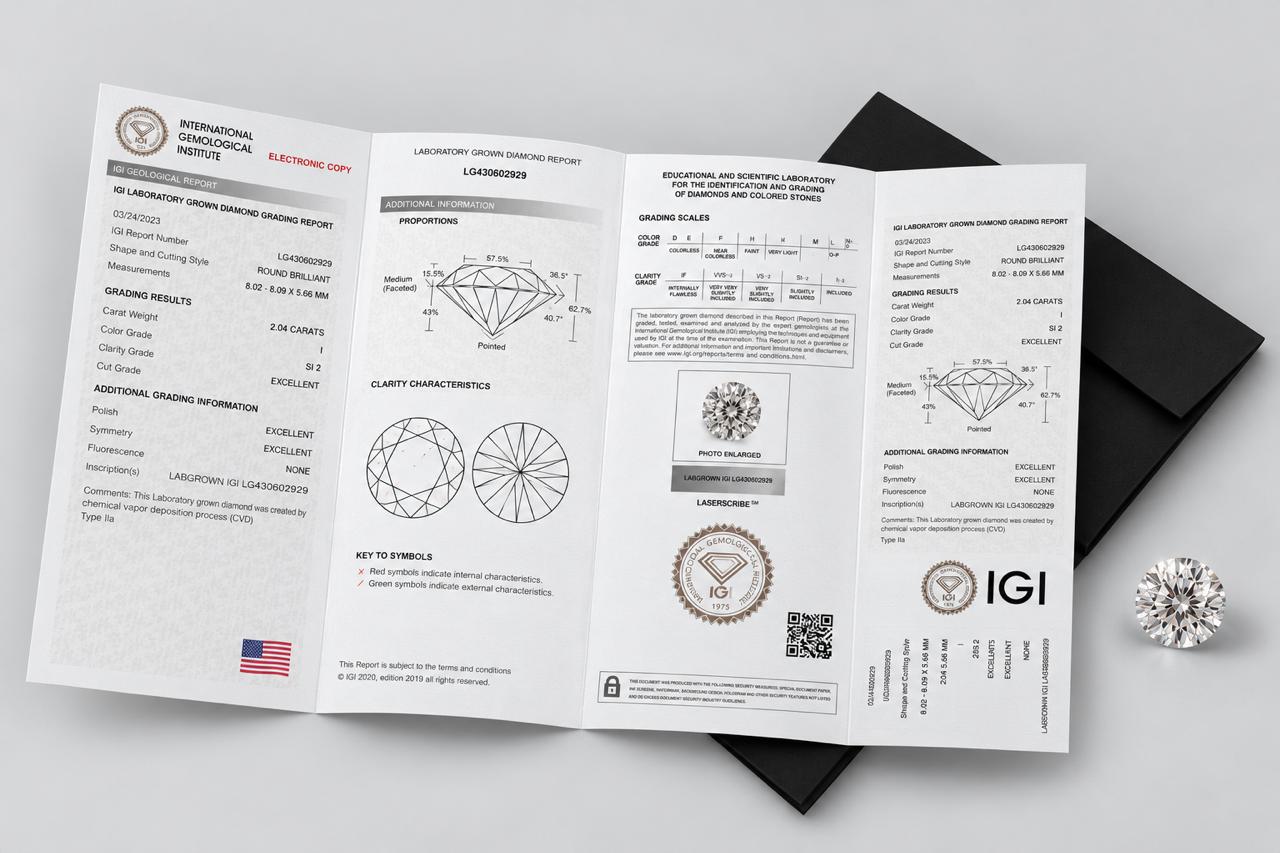
IGI’s position did not develop by chance. The laboratory began issuing reports for lab-grown diamonds as early as 2005 — long before this category became mainstream.
This allowed IGI to build significant expertise specifically in working with stones produced using HPHT and CVD methods, as well as to develop a report format familiar to both manufacturers and buyers.
Today, IGI positions itself as a global leader in lab-grown diamond certification. According to the company, IGI held approximately 65% of the global certification market for this category in 2023.
Therefore, the statement that IGI has become a practical industry standard for lab-grown stones has some basis. At the same time, this figure should be understood specifically as a share of the certification market according to IGI’s own data, rather than as universal statistics covering all lab-grown diamonds worldwide.
Grading strictness: IGI vs GIA
A common belief is that an IGI certificate automatically means a “softer” grade, while GIA always grades stones more strictly. In reality, this is an oversimplification.
Grading strictness depends on the methodology of a particular laboratory, equipment calibration, internal protocols, and the individual stone. Therefore, the rule that “IGI is one grade higher” should not be applied to every diamond.
This is particularly important now that GIA uses the Premium / Standard system for the main category of colorless and near-colorless lab-grown diamonds. A direct comparison such as “GIA G/VS1 versus IGI G/VS1” is no longer appropriate for new GIA Quality Assessments.
For buyers, it is more important to look at the individual stone: its proportions, cut, appearance, and the characteristics listed in the report, rather than trying to determine in advance which laboratory is “stricter.”
Certification cost and diamond price
Another practical difference is the cost of the laboratory service. The price depends on the type of report, the stone’s weight, turnaround time, and additional services, so it would be inaccurate to give one fixed price for every case.
For buyers, another point is more important: a diamond certificate does not itself determine the stone’s market price. The report confirms the diamond’s characteristics, but it is not a valuation or appraisal.
Therefore, a more expensive laboratory brand does not automatically mean a more expensive or higher-quality stone.
What does a buyer receive with a certificate?
A good laboratory report is primarily independent documentation that allows a specific stone to be identified.
A current IGI report for a lab-grown diamond may include:
-
carat weight;
-
shape and cutting style;
-
measurements;
-
color;
-
clarity;
-
cut quality;
-
polish and symmetry;
-
information confirming laboratory-grown origin;
-
where applicable, details about the growth method and post-growth treatments.
The report contains all the key characteristics of the gemstone.
GIA also confirms the laboratory-grown origin of the stone, while its current Quality Assessment for colorless and near-colorless stones classifies them as Premium or Standard. For colored lab-grown diamonds, GIA offers separate reports with more detailed information about color, clarity, growth method, and possible treatments.
This is why a diamond certificate should be viewed not as a “status symbol,” but as a tool for verifying a specific stone.
GIA vs IGI at a glance
| Parameter | GIA | IGI |
|---|---|---|
|
Year founded |
1931 | 1975 |
|
Type of organization |
Nonprofit | Independent commercial gemological laboratory |
|
Main historical specialization |
Natural diamonds and gemology | Diamonds, jewelry, and lab-grown stones |
|
Lab-grown diamonds |
Yes | Yes |
|
Approach to LGDs since 2025 |
Premium / Standard for the main category of colorless and near-colorless LGDs |
Traditional 4Cs system |
|
Color and clarity |
Overall descriptive assessment for current Quality Assessments | Specific D–Z and FL–I3 grades |
|
Origin information |
Confirms laboratory-grown origin | Confirms laboratory-grown origin |
|
Growth method / treatment |
Stated in applicable reports | May be stated in the report |
| Recognition | Particularly strong in the US and for natural diamonds |
Very broad international presence, particularly strong in the LGD segment |
|
Practicality for comparing LGDs |
Fewer specific grades in the new format | High — detailed 4Cs assessment |
|
Secondary market |
Strong brand, particularly for natural diamonds | Widely used in the current LGD market |
SOLO for Diamonds certification
For SOLO for Diamonds, certification is part of our quality control system. Our lab-grown diamonds undergo independent gemological evaluation, including by GIA and IGI.
Production allows the quality of each diamond to be controlled from the selection of the crystal through its subsequent processing. Customers can also view photos of the actual stone rather than stock images. The quality of the lab-grown diamonds, technological approach, and level of craftsmanship were presented at the world-renowned JCK (Jewelry Collective of Las Vegas) exhibition in Las Vegas in 2021, 2023, and 2024.
[products]
Which certificate should you choose for a lab-grown diamond?
For most buyers of lab-grown stones, an IGI certificate is a practical and easy-to-understand choice. Its main advantage is the detailed 4Cs assessment, which allows the characteristics of different stones to be compared directly.
A GIA certificate is also a fully independent document, but new Quality Assessments for lab-grown diamonds use a different system. Its advantage today lies primarily in the strength and historical recognition of the GIA brand, as well as in the format of its report, rather than in the idea that it automatically represents a “better” stone.
If a buyer is considering the secondary market, another nuance should be taken into account: lab-grown diamonds generally have different market dynamics from natural diamonds, and the GIA name alone does not guarantee a higher future resale price.
Therefore, when choosing between IGI and GIA, it is more important to verify that the report is authentic, that its information matches the specific stone, and that the diamond itself meets your requirements for size, color, clarity, and cut. This helps ensure that the stone is genuine and that its characteristics correspond to the information stated in the report.
FAQ
Can you obtain both IGI and GIA reports for the same diamond?
Can IGI be trusted as much as GIA?
What does a GIA certificate mean?
What is an IGI certificate?



you may also be interested in
14.08.26
7 myths about lab-grown diamonds that are time to dispelAre lab-grown diamonds real or not? We explain in simple terms how they differ from natural diamonds and what to consider when choosing a piece of jewelry. We separate facts from common misconceptions to help you better understand the stone and make an informed choice.
read22.07.26
Diamond engagement ring. A tradition that became a symbol of loveA marriage proposal is one of the most important moments in the lives of two people. Today, it is almost impossible to imagine it without a piece of jewelry that has become a universal symbol of commitment, trust, and the desire to build a future together.
read05.08.26
What are lab-grown diamonds: a complete guide in simple wordsLab-grown diamonds are real gemstones that differ from natural diamonds only by their origin. Discover everything you need to know about HPHT and CVD technologies, certification, differences from natural diamonds, and key factors to consider when choosing a diamond.
read05.08.26
HPHT vs. CVD: how are diamonds really grown in a laboratory?Discover how modern technology transforms carbon into a real diamond, the stages each crystal goes through, and the key differences between the HPHT and CVD growing methods.
read whatsapp
 Telegram
 EMail
EMail